Showing posts with label icing. Show all posts

Wednesday, February 29, 2012

Basketweave Using Magic Tip #2B

Today I learned how to do the basketweave on a cake for the final project in Wilton Course 2: Flowers and Cake Design. Basketweave can be done with a variety of tips, including star, flat, serrated, or a combination of 2 (one piping vertical lines, one piping horizontal). Based on the sheer size of my cake, I decided to work with a rather large tip, the #2B by Magic Tip, which is a good half inch wide. On one side it's flat: 
And on the other it's serrated. This is the texture I used, so this is the side that was facing away from the cake the whole time I was piping. 
Start by icing a cake and chilling it. It does not necessarily need to be the same color as your basketweave icing. This one is a 13 by 9 oval, made of three alternating vanilla and chocolate layers that took one box mix each to make:
Start by marking vertical lines all the way around the cake. For a cake of this size, I used a large straight spatula as a guide. 
 I traced a guide line in the icing along the spatula's edge with a second, smaller spatula. The lines are one large spatula's width apart.

 Start by loading a large pastry bag with whichever tip you'd like and medium consistency icing. You can either pipe from the top to the bottom or from the bottom to the top (the latter seemed to be the favorite method of most of the folks in the class, including myself):
 I apologize for any piping you see to the left of this vertical line; I hope it won't distract you. I felt like I needed to get a few inches of practice in before I started to take photos. It is OK for the vertical lines to overlap onto the surface of the cake; they'll be covered with borders, flowers, etc. eventually. Begin by piping a horizontal line from one guide line to another; this will form a "T" with your vertical line:
 This short line is known as a "spacer dot." It is piped on the guide line directly below where the top right edge of the "T" ends:
 Repeat these two steps; the horizontal line…
 And the spacer dot. This, by the way, is definitely best practiced on a sheet of parchment or waxed paper before it's attempted on a cake.
 On this cake there was room for one more horizontal line at the base. Notice how the guide line is still barely visible under the spacer dots and right edges of horizontal lines?
 Pipe a vertical line from the base to the top of the cake and finish off that line:
 You will be repeating and reversing this process all the way around the cake. I promise, your speed will improve in no time. I would have finished this cake in well under an hour if I hadn't spent so much time chatting with everyone in the class! So, at the top of the next guide line, pipe a spacer dot:
 Beneath it, tuck the tip into that hole in the icing (that my instructor refers to appropriately as a "window") and pipe a horizontal line from the window over to the guide line, ending below the spacer dot.
 Pipe another spacer dot beneath this horizontal line on the guide line…
  …another horizontal line…
…and a final spacer dot beneath it:
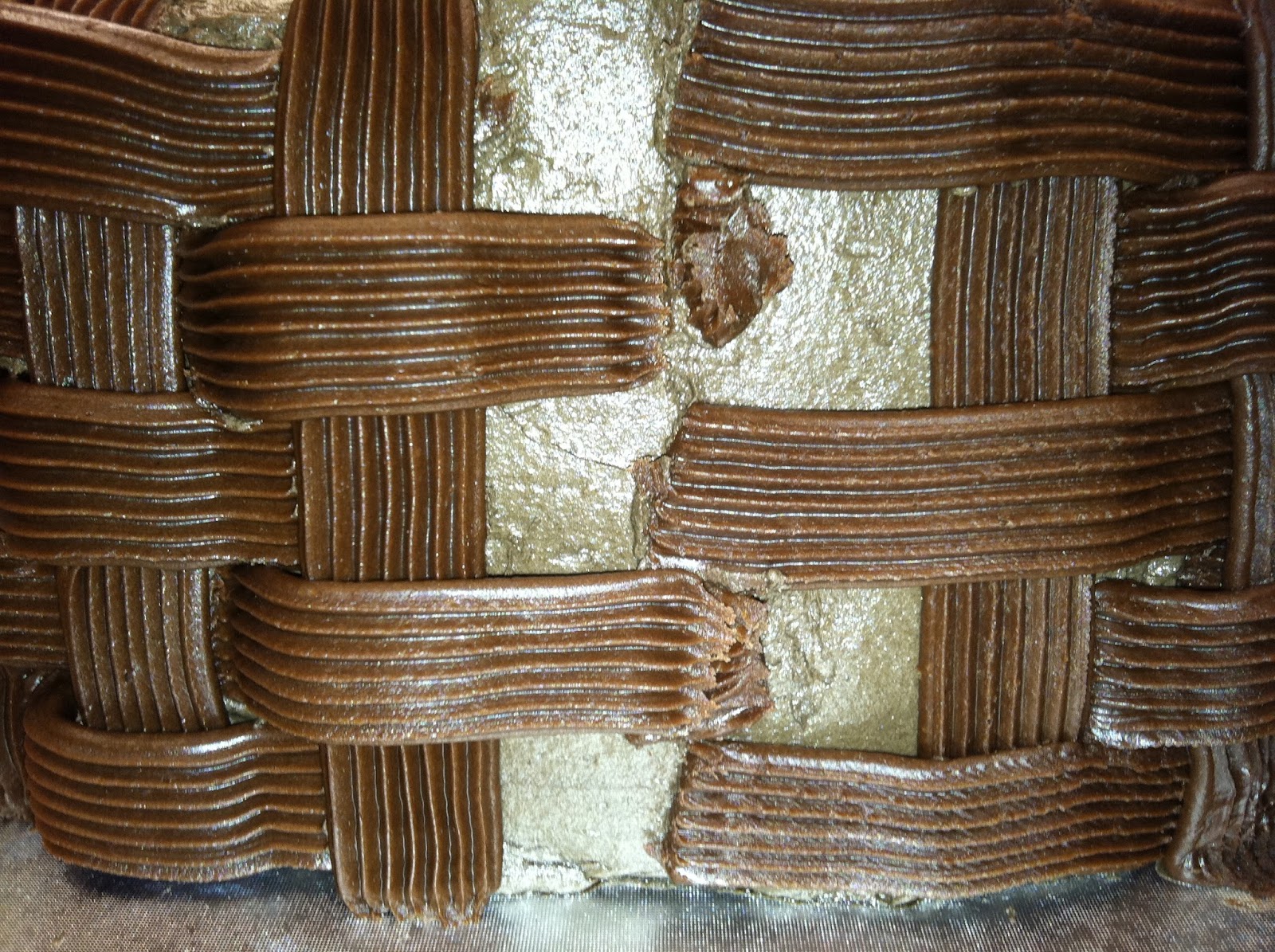
 Pipe a vertical line over all these ends along the guideline, and by now you should be able to see the basketweave take shape:
 When you get to the end (which will undoubtedly become the "back of the cake" where various seams wind up), here is how to finish it off.
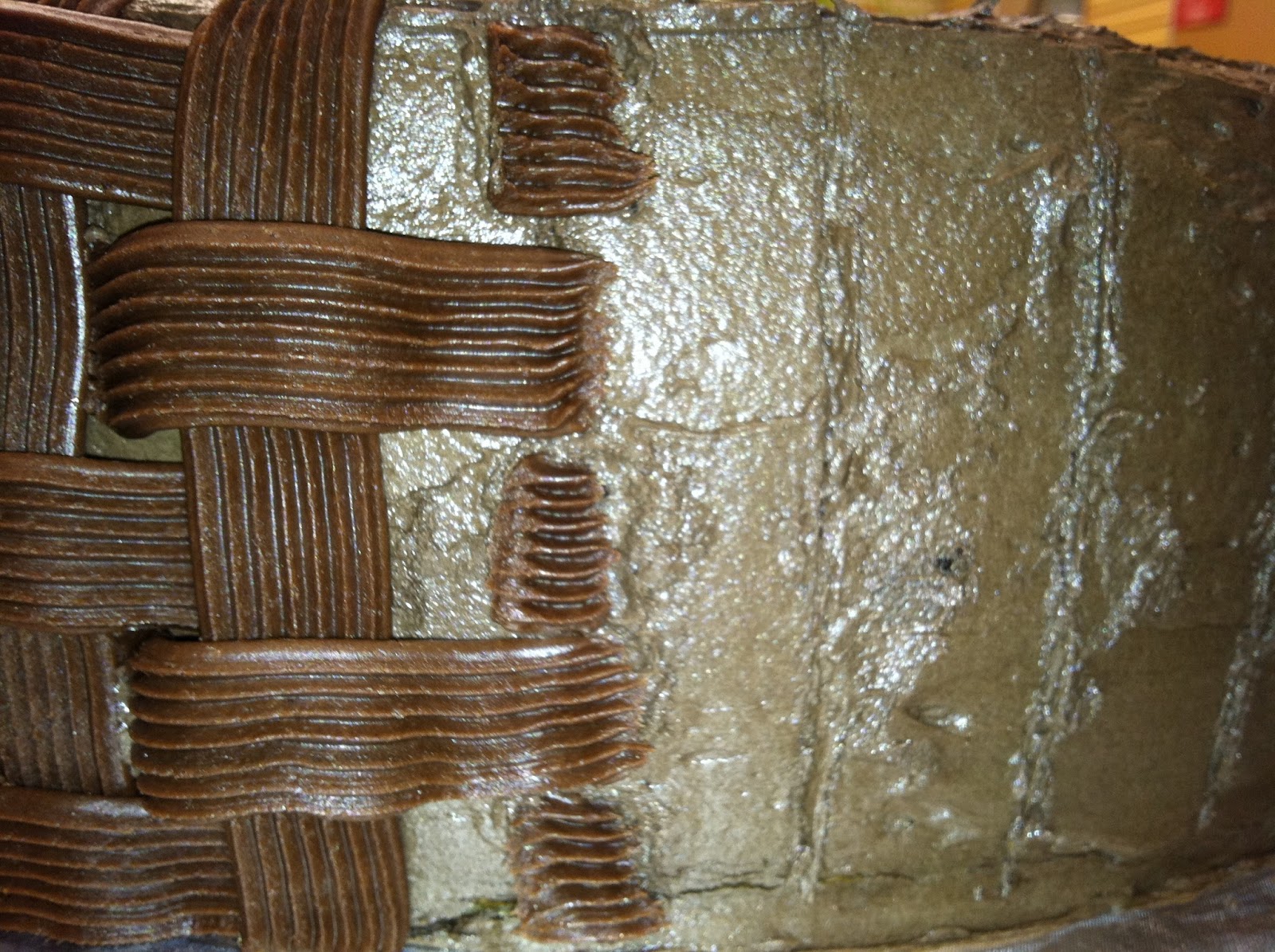
Pipe a vertical line over the spacer dots and ends of vertical lines:

 On the left, pipe a short horizontal line that goes from the "window" to the right edge of that vertical line:
 In the next "window" down on the right, pipe a very short horizontal line:
 Repeat the horizontal line that goes from the next "window" down to the vertical line's right edge:
 Pipe another very short line in the next "window" down to the right of the horizontal line:
 And finish with a final horizontal line from the "window" to the right edge of the vertical line:
 As you can probably tell, this cake is a work in progress; more to come soon!

Thursday, January 5, 2012

Royal icing pieces

I have this bowl of royal icing left over from the snowflake cookies, and I thought of something to do with it: royal icing pieces. I'm making a birthday cake for a guy friend, and I wanted to do something other than lots of frosting flowers, drop strings, etc. The technique is simple: pipe designs onto waxed paper stuck to cookie sheets with tape. You can do this freehand, or slip a piece of paper with a design on it under the waxed paper and trace over it with the icing directly onto the waxed paper. Several hours later the icing will be dry and can be lifted carefully off with the aid of an offset spatula. The likelihood of breakage exists, so it's always important to make extras. It's possible to make extremely delicate, intricate pieces, but such was not the case with my first attempt at this technique. Perhaps because my icing was tired from sitting in the fridge or perhaps because I didn't have a #2 tip (#1 was really too tiny for what I had in mind and the #3 I used wound up being a bit too massive), the results look a bit like I tried to get creative with a travel-sized tube of toothpaste. Here's the first batch I made, featuring lots of random shapes:
(note all the cubes; a nod of the head to my friend being into games that involve dice). Just as I was about to call it a night, I thought of a nice alternative to those hideous number candles; how about Roman numerals (33)?
Incidentally, only one piece of all I made suffered any breakage, and I was able to repair it with a tiny dab of icing; the repair is to that little tail on the left:
I'll post photos of the finished cake; hopefully it'll be yummy. I'm looking forward to crunching into those royal icing pieces; I actually really like how royal icing tastes! The Wilton book Decorating Cakes cracks me up with its rather unappetizing description of royal icing: "…you'll use it less for its taste than for its 'indestructible' quality." More for me!

Sunday, January 1, 2012

Tips vs. Tubes

The cake decorating supply company Wilton calls them tips, Ateco calls them tubes. I think "tube" is a bit of a misnomer; it suggests something cylindrical, whereas "tip" describes where on the decorating bag it's located. In a short span of time I've amassed a vast array of tips, mostly because they tend to run pretty cheap (between $1 and $3). Some of the standouts pictured in the multi-tip pileup above include one that pipes 3 stars simultaneously (far left; ideal for covering large areas with stars), a wide icer tip (that toothy monster toward the middle; I prefer to ice cakes with an offset spatula but the icer tip gets the job done), a Christmas tree tip (ideal for piping a cute little detail when you don't have the time to draw something freehand), and a long cupcake filler tip (to the right of the tree, standing almost as tall as the wide icer tip; get two or more of these and you can inject as many fillings as the cupcake will hold, such as peanut butter and jelly).
Invariably when I go shopping for tips I get carried away. I would wind up with unintentional duplicates of tips if I didn't carry lists of those I have (by brand) in the "Notes" app on my phone. I like to load up a decorating bag and take to my practice board with the new tips as soon as possible, always including the number of the tip…
…and then I have the photos to refer to the next time I have a blank-slate cake staring me in the face. Ateco produced a terrific book, the Ateco Cake Decorating Reference Manual, which is pretty much nothing more than 20 pages chock-full of images like the one above. All of their examples are shown life-size, and in white icing. I think white icing does look more palatable in photos than brown, but soon I'll post the reason why I happened to have a decorating bag loaded with chocolate icing (and the 195 tip) lying around.
I hope 2012 is off to a great start for you!

Saturday, December 31, 2011

Farewell, 2011…

My New Year's Resolution is to attempt to master as many cake decorating skills as possible, and to share what I learn here. I have a wild idea that I might be able to come up with 365 posts by this time next year, but realistically my posts will probably come in fits and starts. Even more realistically, they might have less to do with cake decorating and more to do with the general "icing" of everything domestic; the reinterpretation of a classic recipe, a crafty decorating idea, or a creative method of tackling housework.
Back to cake decorating, my friend Joe cracks me up by regularly asking me, "What's with all these cakes?" The deal with "all these cakes" is in early 2011 I discovered and fell in love with the TLC show Cake Boss, and watching it inspired me to sign up for the beginner's cake decorating class at my local Michael's Arts & Crafts store. I plan to take more classes at Michael's and beyond, but I've found that some of my greatest cake-related accomplishments have occurred when I'm tinkering around in my own kitchen…or even in a hotel room.
On the eve of July 4th I was staying with my family at a Residence Inn, where I made myself at home by covering every flat surface of the kitchenette with paper towels. I proceeded to set up a "Fireworks Cookies" factory, which seems appropriate to revisit tonight on New Year's Eve. As you can see, the cookies were clearly a rip-off of the July cover of Martha Stewart Living; you can get the instructions here: Fireworks Cookies. The main thing I learned from this experiment is it's essential to own at least three each of all the smallest decorating tips for icing. I would have gone insane if I'd had to constantly swap my only #2 tip between piping bags of red and blue royal icing, both of which are threatening to dry out. Oh, and having to clean and dry the tip every time!? I'd have just splattered all the cookies Jackson Pollock-style and been done with it. Come to think of it, that might be a rather stunning cookie…now it's on the "to do" list!
Happy 2012, and good luck with your New Year's Resolutions! I'll try my hardest to stick to mine.